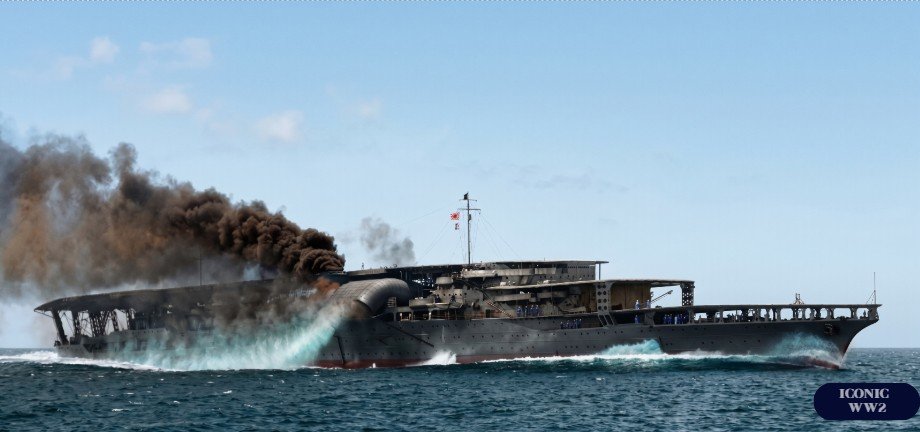
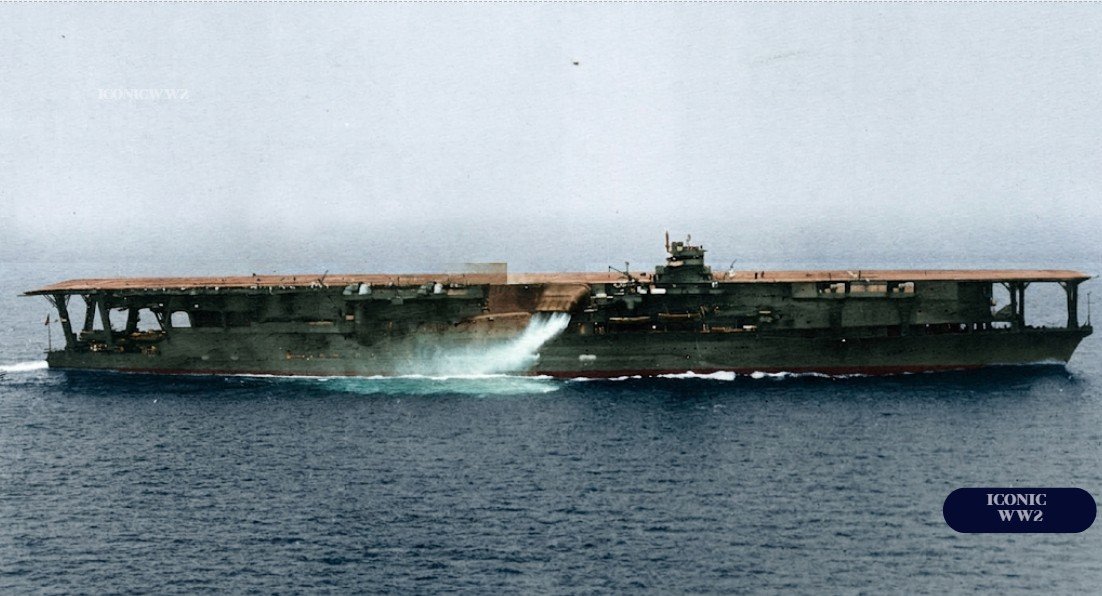
The Hiryū was Japan’s answer to the lessons of its first purpose-built fast carriers. Laid down in 1936 as an enlarged, improved half-sister to the Sōryū, she was launched on 16 November 1937 and commissioned on 5 July 1939 — a sleek ship of about 20,570 tonnes full load, driven at 34 knots by some 153,000 shp, built for the speed and range the Imperial Navy’s carrier doctrine demanded.
One feature set her apart from almost every carrier afloat: her small navigating island was mounted on the port side, one of only two Japanese carriers so built — the other being the flagship Akagi. The theory was that a port-island ship steaming beside a conventional starboard-island one would ease the coordination of their two air groups. In practice the arrangement disturbed the airflow over the flight deck, and it was never repeated.
When war came, Hiryū sailed as part of the Kidō Butai, the six-carrier First Air Fleet that was the most powerful naval striking force in the world. Her aircraft were in the skies over Pearl Harbor on 7 December 1941, and she went on to support the capture of Wake Island later that month, ranging across the Pacific as Japan’s conquests spread almost unchecked.
She carried about 64 aircraft — roughly 18 A6M Zero fighters, 18 D3A “Val” dive bombers and 18 B5N “Kate” torpedo bombers — flown by aircrew who had trained for years and, many of them, had already fought over China. The Imperial Navy’s training pipeline was deliberately small and slow, built to produce a limited number of superb pilots rather than a large number of adequate ones.
In April 1942 the Kidō Butai swept into the Indian Ocean, and Hiryū’s dive bombers went with it. On 5 April they caught the heavy cruisers HMS Cornwall and HMS Dorsetshire in open water, and sank them both in minutes — Cornwall reportedly going down in about twelve minutes under nine bomb hits and six near misses. Four days later, on 9 April, the same crews sank the carrier HMS Hermes and the Australian destroyer HMAS Vampire.
The accuracy is what stands out. Against warships manoeuvring at speed in open sea — the hardest target a dive bomber can be given — the D3A crews of the raid are credited with a hit rate of around 80 per cent, a standard no other naval air arm in the world came close to in 1942. From Pearl Harbor to Ceylon, in six months of war, the Kidō Butai had not lost a single carrier.
That run ended on the morning of 4 June 1942. Four carriers of the Kidō Butai — Akagi, Kaga, Sōryū and Hiryū — had been sent to take the atoll of Midway and destroy the American fleet, but US codebreakers had read the plan and three carriers lay in wait. At about 10:20, in the space of only a few minutes, American SBD Dauntless dive bombers plunged out of the sky and left Akagi, Kaga and Sōryū ablaze.
Hiryū, steaming a little apart from the others, was the only one of the four to escape that annihilating strike. Under Rear Admiral Tamon Yamaguchi — widely regarded as one of Japan’s finest carrier commanders — she now stood alone against an enemy she still believed she could beat, and she wasted no time in striking back.
Hiryū launched two attacks in quick succession, both aimed at the American carrier they had located: the USS Yorktown. The first, around midday, was a wave of D3A “Val” dive bombers led by Lieutenant Michio Kobayashi; they fought through the defending fighters and planted three bombs on Yorktown, briefly bringing her to a stop.
The second, that afternoon, was a strike of B5N “Kate” torpedo bombers led by Lieutenant Jōichi Tomonaga — who flew knowing that his aircraft’s damaged fuel tank might leave him no way home, and did not return. Two of his torpedoes struck Yorktown and crippled her for good; she was finished off by a submarine three days later. Hiryū had, almost single-handedly, knocked one of the three American carriers out of the battle.
Her defiance could not last. Late that afternoon, SBD Dauntlesses from the Enterprise — some of them Yorktown’s own orphaned aircraft — found Hiryū and dived on her. Four bombs struck home forward, tearing up the flight deck, wrecking the forward elevator and igniting fires that spread beyond all hope of control. The last carrier of the Kidō Butai was doomed.
Through the night her crew fought the flames in vain, and in the early hours of 5 June 1942 she was abandoned and scuttled by a Japanese destroyer’s torpedoes. Rear Admiral Yamaguchi and her captain, Tomeo Kaku, chose to remain aboard and go down with the ship — the loss of a commander Japan could ill afford, alongside hundreds of her crew.
The scuttling did not account for everyone aboard. When Hiryū was abandoned before dawn on 5 June, 35 men of her engineering force were still below in the machinery spaces, cut off and left for dead. As the ship went down they made their way topside, found a boat, and got clear of her.
Then they sailed. For two weeks they worked across an empty ocean trying to reach friendly territory, until an American search aircraft spotted the boat. USS Ballard picked them up on 19 June 1942, a fortnight after the battle that had killed their ship; one of the 35 died on the passage to Midway and was buried at sea. The others went on to Pearl Harbor as prisoners of war.
- Jonathan Parshall & Anthony Tully, Shattered Sword: The Untold Story of the Battle of Midway (Potomac, 2005).
- Gordon W. Prange, Donald M. Goldstein & Katherine V. Dillon, Miracle at Midway (McGraw-Hill, 1982).
- Mark R. Peattie, Sunburst: The Rise of Japanese Naval Air Power (Naval Institute Press).
- Mitsuo Fuchida & Masatake Okumiya, Midway: The Battle That Doomed Japan (Naval Institute Press) — a participants’ account.
Iconic WW2 is free, ad-free and tracker-free — kept going only by the time it takes to research, restore and colorize each machine. If this profile was worth your read, you can help the archive grow.
| Builder | Yokosuka Naval Arsenal |
| Nation | Japan |
| Class | Hiryū (improved Sōryū) |
| Type | Fleet aircraft carrier |
| Commissioned | 5 July 1939 |
| Fate | Sunk at Midway, 5 June 1942 |
| Total | ~64 aircraft |
| Fighters | ~18 A6M Zero |
| Dive bombers | ~18 D3A “Val” |
| Torpedo bombers | ~18 B5N “Kate” |
| Machinery | Geared steam turbines |
| Boilers | 8 Kampon |
| Shafts | 4 |
| Power | ~153,000 shp |
| Max Speed | ~34 knots |
| Range | ~7,670 nm at 18 knots |
| Crew | ~1,100 |
| Island | Port side (unusual) |
| Length | 227.4 m |
| Beam | 22.3 m |
| Draught | ~7.7 m |
| Displacement | ~20,570 t (full load) |
| Dual-purpose guns | 12× 12.7 cm |
| Anti-aircraft | ~31× 25 mm |
| Pearl Harbor | December 1941 |
| Indian Ocean | Sank Cornwall, Dorsetshire, Hermes |