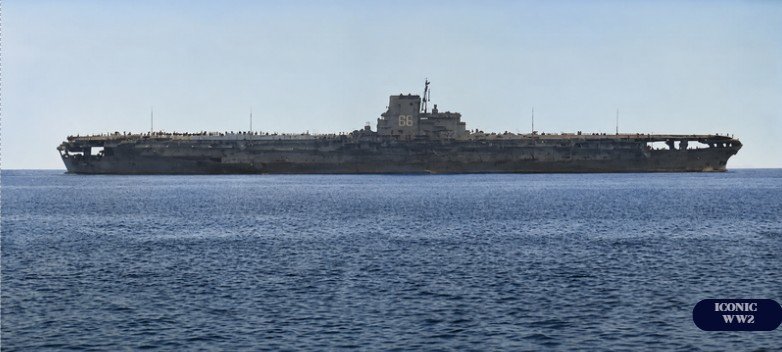
Kaga began life as something else entirely. She was laid down in 1920 as a battleship of the Tosa class, one of the giants of Japan’s planned battle fleet — until the Washington Naval Treaty of 1922 halted the great battleship race and condemned her half-built hull to the scrapyard.
She was saved by an accident. When the great earthquake of 1923 wrecked the battlecruiser Amagi, already earmarked for conversion into an aircraft carrier, the navy substituted Kaga’s spare battleship hull in her place. Rebuilt with a flight deck, she was commissioned as a carrier on 31 March 1928 — a battleship reborn as a ship of the air age.
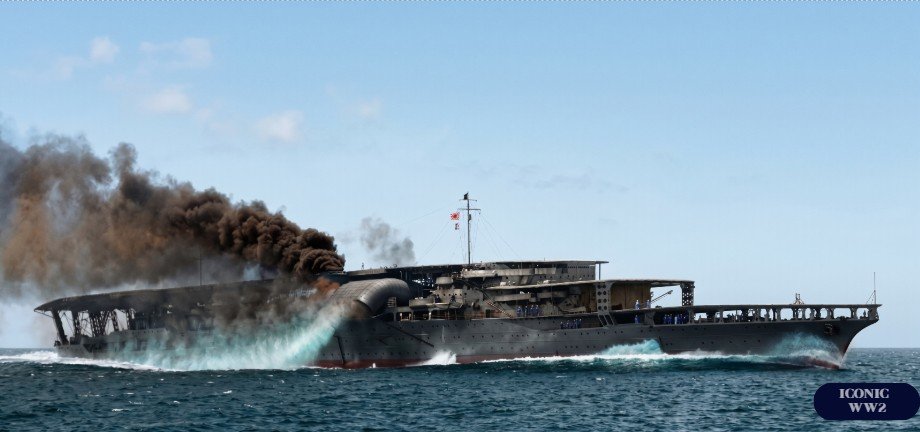
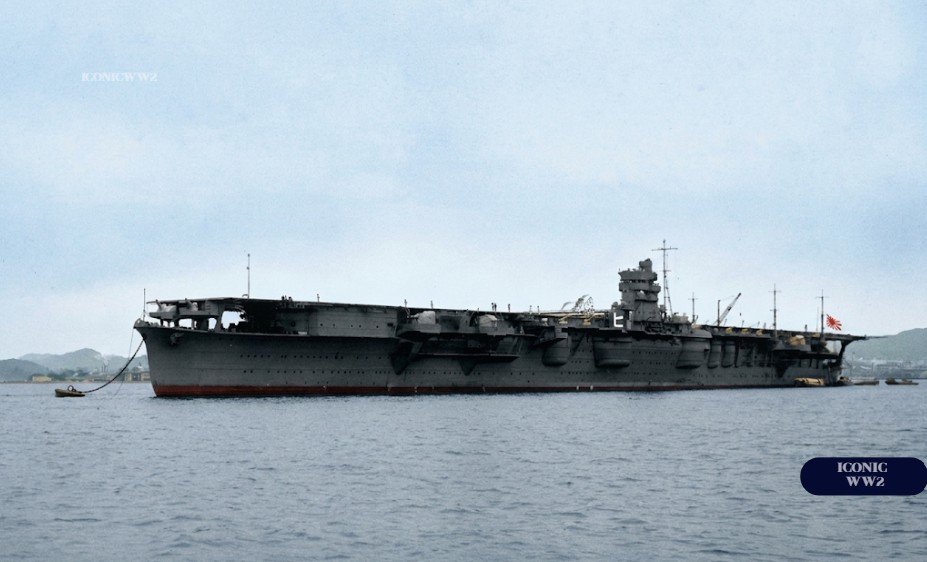
As first completed she was an awkward experiment, with stepped flying-off decks and long horizontal funnels venting down her sides. Between 1934 and 1935 she was rebuilt almost from the waterline up: a single full-length flight deck, a small starboard island, and a distinctive trunked funnel curving down to starboard. The reconstruction raised her to some 38,200 tonnes and let her operate the largest air group of any Japanese carrier — around ninety aircraft.
That size came at a price. Her machinery, even rebuilt to about 127,000 shp, could push her to only some 28 knots — several knots slower than the fast fleet carriers Hiryū and Sōryū she served alongside, and a persistent tactical handicap. But she carried more aircraft than any of them, and in the doctrine of massed carrier air power that Japan was pioneering, that counted for a great deal.
Kaga went to war long before Pearl Harbor. Her aircraft were in action over Shanghai in 1932, flying some of the earliest carrier air strikes in history, and again from 1937 in the Second Sino-Japanese War, bombing Chinese cities and airfields far inland.
These operations were a proving ground for the men and the methods that would later stun the world. The aircrews who honed their skills over China became the veteran core of the Kidō Butai, and the techniques of massed, long-range carrier strikes were rehearsed in those campaigns years before they were unleashed on the United States Navy.
On 7 December 1941 Kaga was one of the six carriers that struck Pearl Harbor. Her dive- and torpedo-bombers were among the most destructive of the morning — and she paid for it, losing more aircraft than any other carrier in the strike. Through the months that followed she ranged with the Kidō Butai across the Pacific, from the devastating raid on Darwin to the conquest of the Dutch East Indies.
She missed the fleet’s triumphant Indian Ocean raid of April 1942, having run aground on a reef and returned to Japan for repairs. It was a lucky escape that only postponed her end: when the Kidō Butai sailed for Midway two months later, Kaga sailed with it.
On the morning of 4 June 1942, Kaga’s decks were crowded with fuelled and armed aircraft when the SBD Dauntless dive bombers of the Enterprise plunged on the Japanese carriers. About four bombs struck her in moments; one burst near the bridge, killing the captain and most of the command staff, while the others tore into the packed hangars and turned the ship into an inferno.
There was no saving her. The fires raged out of control all day, and that evening the largest carrier of the Kidō Butai was abandoned and went down, taking more than 800 of her crew with her — the heaviest loss of life of the four carriers destroyed at Midway. Her wreck was found on the deep Pacific floor in 2019, almost eighty years after she sank.
Kaga was the odd giant of the Kidō Butai: a converted battleship, the slowest of the fast carriers, yet the one that carried the most aircraft and struck some of the heaviest blows. From the skies over Shanghai to the flames of Midway, her career spanned the whole rise and fall of Japanese carrier aviation.
She died in the space of a single morning, one of four irreplaceable carriers lost in the minutes that turned the Pacific war. In her destruction, and that of her sisters, the offensive power that had carried Japan from Pearl Harbor to Ceylon was broken for good — and the age of the carrier she had helped pioneer passed decisively into American hands.
- Jonathan Parshall & Anthony Tully, Shattered Sword: The Untold Story of the Battle of Midway (Potomac, 2005).
- Mark R. Peattie, Sunburst: The Rise of Japanese Naval Air Power (Naval Institute Press).
- Gordon W. Prange, Miracle at Midway (McGraw-Hill, 1982).
Iconic WW2 is free, ad-free and tracker-free — kept going only by the time it takes to research, restore and colorize each machine. If this profile was worth your read, you can help the archive grow.
| Builder | Kawasaki, Kobe (as battleship) |
| Nation | Japan |
| Origin | Tosa-class battleship hull |
| Type | Fleet aircraft carrier |
| Commissioned (carrier) | 31 March 1928 |
| Reconstructed | 1934–35 |
| Fate | Sunk at Midway, 4 June 1942 |
| Total | ~72–90 aircraft (fleet’s largest) |
| Fighters | A6M Zero |
| Dive bombers | D3A “Val” |
| Torpedo bombers | B5N “Kate” |
| Machinery | Geared steam turbines |
| Boilers | 8 Kampon |
| Shafts | 4 |
| Power | ~127,400 shp |
| Max Speed | ~28 knots |
| Range | ~10,000 nm at 16 knots |
| Crew | ~1,700 |
| Note | Slowest of the Kidō Butai carriers |
| Length | 247.6 m |
| Beam | ~32.5 m |
| Draught | ~9.5 m |
| Displacement | ~38,200 t (standard) |
| Heavy guns | 10× 20 cm |
| Anti-aircraft | 16× 12.7 cm DP |
| Pearl Harbor | December 1941 |
| Wreck found | 2019 (deep Pacific) |