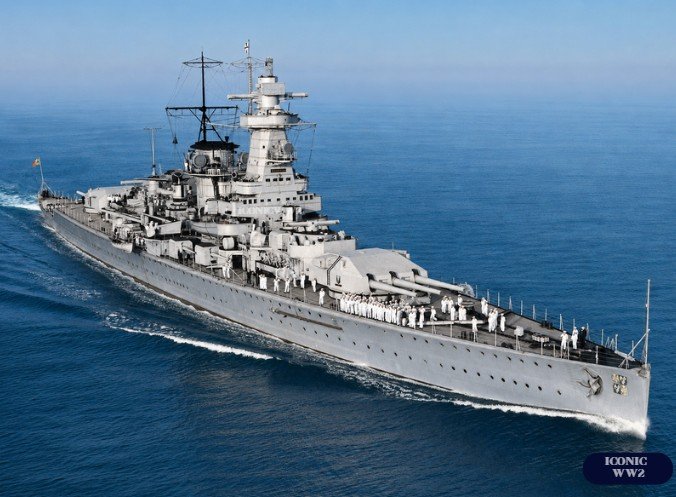
Prinz Eugen was the third and finest of the German Admiral Hipper-class heavy cruisers, named for the great 18th-century soldier Prince Eugene of Savoy. Like the Italian Zaras, she was a 'treaty cruiser' in name only: nominally bound by the 10,000-ton limit, she in fact displaced close to 16,970 tons standard, and far more at full load.
Commissioned in August 1940, she carried eight 20.3 cm (203 mm) SK C/34 guns in four twin turrets and could make over 32 knots. Heavily built and handsome, she was also famously complex and fuel-hungry — but she would prove one of the luckiest warships of the entire war.
The Hipper class were large, powerful and technically advanced, but their three-shaft geared turbine plant of ~132,000 shp was elaborate, maintenance-intensive and thirsty, giving the ships a disappointing radius of action for commerce raiding. Protection was moderate for their size — a belt of around 70–80 mm — placing them between a true heavy cruiser and a light capital ship.
Prinz Eugen's strengths lay in her excellent optical fire control and her fast, accurate main battery, which she would demonstrate to devastating effect at the Denmark Strait. Her standard displacement of roughly 16,970 t, full-load figure near 18,750 t, and speed of 32 knots made her among the most formidable cruisers afloat — when fuel and machinery allowed her to put to sea at all.
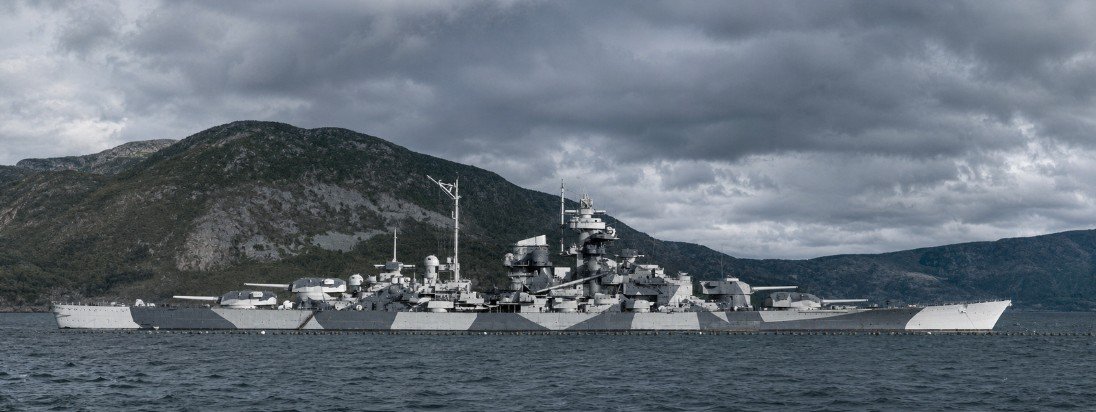
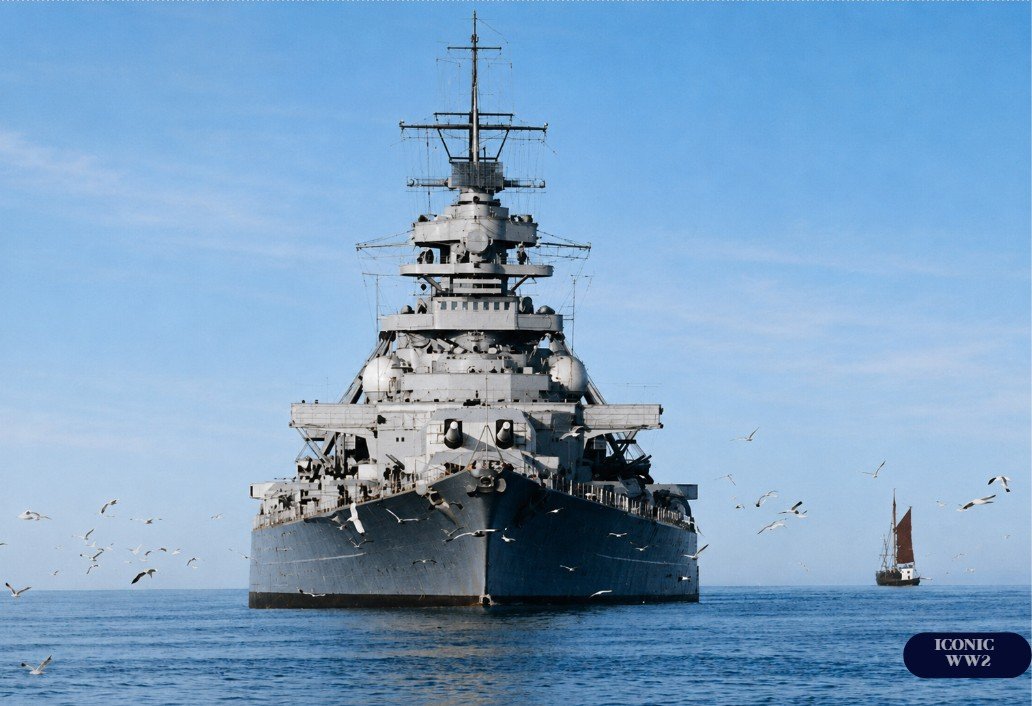
In May 1941 Prinz Eugen sailed on Operation Rheinübung as consort to the battleship Bismarck. On the morning of 24 May, in the Battle of the Denmark Strait, the two German ships engaged the British battlecruiser Hood and the new battleship Prince of Wales.
Prinz Eugen, leading, opened fire with great accuracy and her 20.3 cm shells are believed to have started a fire on Hood's deck moments before Bismarck's salvo blew the battlecruiser apart, killing all but three of her 1,418 men. The cruiser also scored hits on Prince of Wales. Detached afterwards to raid alone, she suffered engine trouble and slipped into Brest, while Bismarck was hunted down and sunk — Prinz Eugen surviving the operation that destroyed her famous partner.
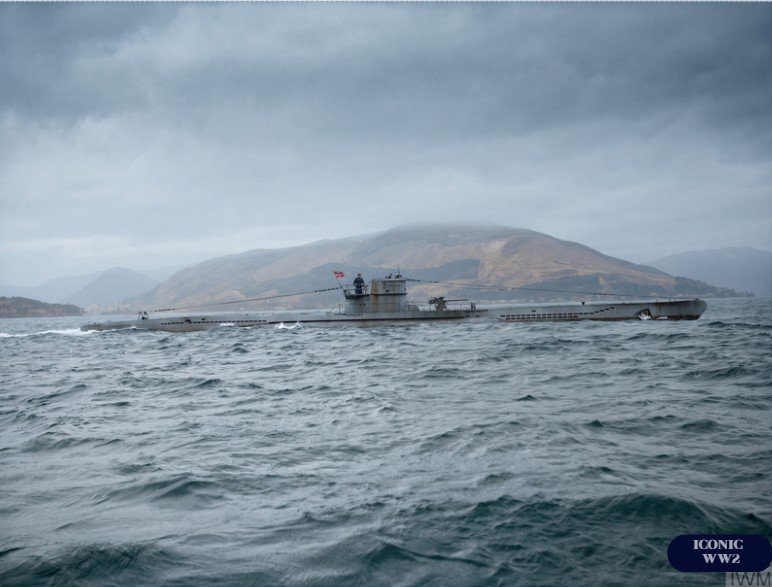
In February 1942 Prinz Eugen took part in the audacious Channel Dash (Operation Cerberus), steaming with Scharnhorst and Gneisenau up the English Channel in broad daylight from Brest to Germany. Days later, off Norway, she was torpedoed by the submarine HMS Trident, which blew off her stern; she limped home and was repaired.
For the rest of the war she served chiefly in the Baltic, where in 1944–45 her 20.3 cm guns provided heavy shore bombardment in support of German armies retreating before the Soviet advance. In October 1944 she accidentally rammed and sank the light cruiser Leipzig in fog. Through air raids, mines and torpedoes she remained, improbably, afloat and operational to the very end.
From mid-1944 Prinz Eugen became, in effect, the heavy artillery of the collapsing Eastern Front. Operating from Gotenhafen, she fired thousands of 20.3 cm rounds in support of the army: at Tukums in August 1944 her guns helped reopen the land corridor to Army Group North, and through the autumn and winter she pounded Soviet spearheads on the Sworbe peninsula and in Samland and East Prussia, shooting until her barrels wore out.
She also covered the seaborne exodus of Operation Hannibal — the evacuation of some two million soldiers and refugees across the Baltic, the largest such operation in history. When the war ended she was in Copenhagen, intact, with ammunition nearly spent: the last operational heavy unit of the Kriegsmarine.
Prinz Eugen was the most successful and longest-lived of Germany's major surface warships — not through great victories, but through sheer survival. She fired the opening shots of the war's most famous battleship duel, ran the gauntlet of the Channel, and fought to the last in the Baltic while every one of her larger consorts was sunk.
She outlived the Kriegsmarine itself. Surrendered intact in 1945 and handed to the United States, she was expended as a target in the 1946 atomic-bomb tests at Bikini Atoll, surviving the blasts only to capsize at Kwajalein months later — where her wreck still lies. The 'lucky ship' of the German navy met her end not to an enemy shell, but to the nuclear age she had outlasted the war to see.
- Gerhard Koop & Klaus-Peter Schmolke, Heavy Cruisers of the Admiral Hipper Class (Naval Institute Press).
- Angus Konstam, German Heavy Cruisers 1939–45 (Osprey, New Vanguard).
- M. J. Whitley, German Cruisers of World War Two (Arms & Armour).
Iconic WW2 is free, ad-free and tracker-free — kept going only by the time it takes to research, restore and colorize each machine. If this profile was worth your read, you can help the archive grow.
| Class | Admiral Hipper |
| Builder | Germaniawerft, Kiel |
| Nation | Germany |
| Type | Heavy cruiser |
| Commissioned | 1 August 1940 |
| Fate | Bikini A-bomb tests, 1946 |
| Crew | ~1,380 |
| Ships Completed | 3 |
| Admiral Hipper | Lead ship; scuttled 1945 |
| Blücher | Sunk at Oslo, April 1940 |
| Prinz Eugen | Survived war; sunk 1946 |
| Machinery | 3× geared steam turbines |
| Boilers | 12 high-pressure |
| Power | ~132,000 shp |
| Shafts | 3 |
| Max Speed | ~32 knots |
| Range | ~6,800 nmi at 20 kn |
| Standard Displacement | ~16,970 t |
| Full Load | ~18,750 t |
| Length | 212.5 m |
| Beam | 21.7 m |
| Draught | ~7.2 m |
| Main Battery | 8× 203 mm /60 SK C/34 (4×2) |
| Secondary | 12× 105 mm DP + AA |
| Torpedoes | 12× 533 mm tubes |
| Belt Armour | 70–80 mm |