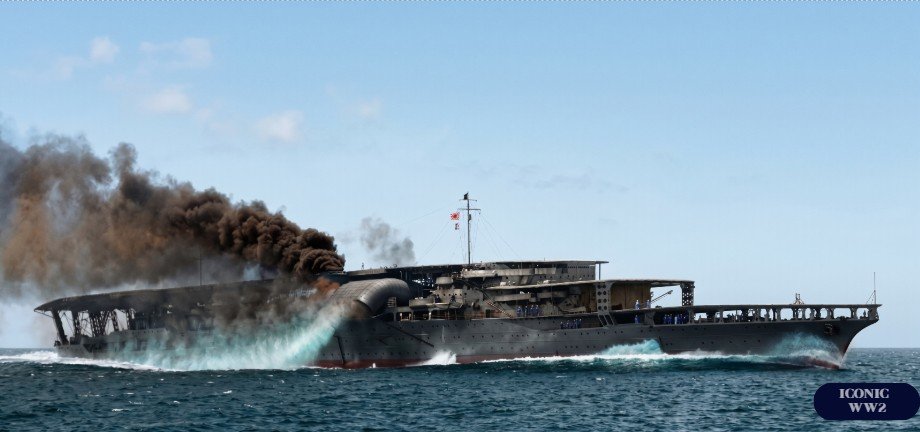
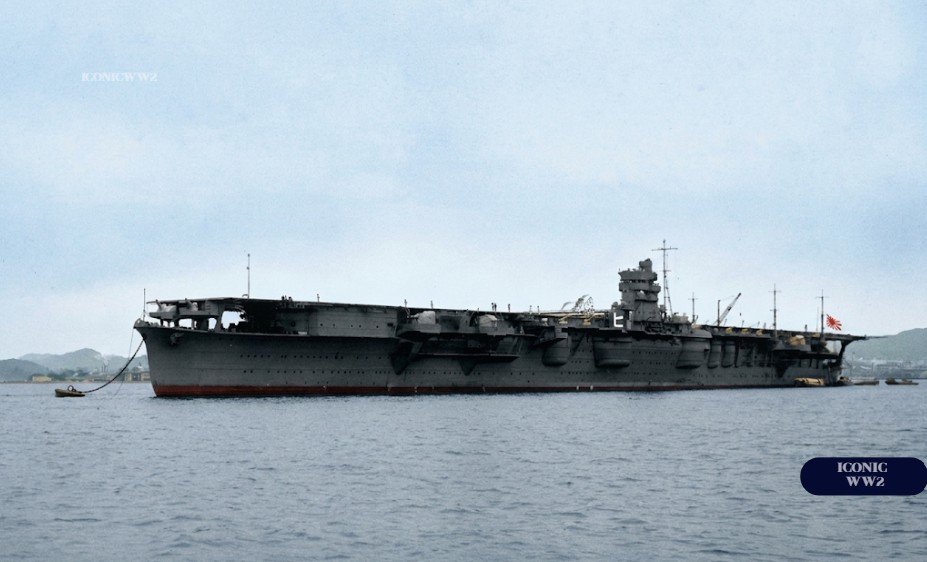
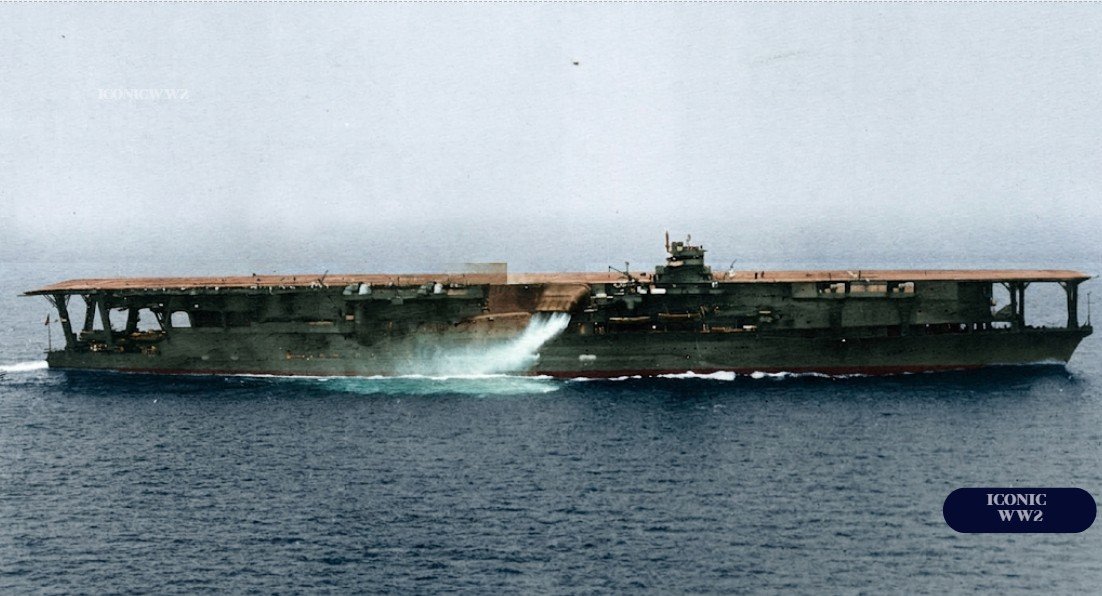
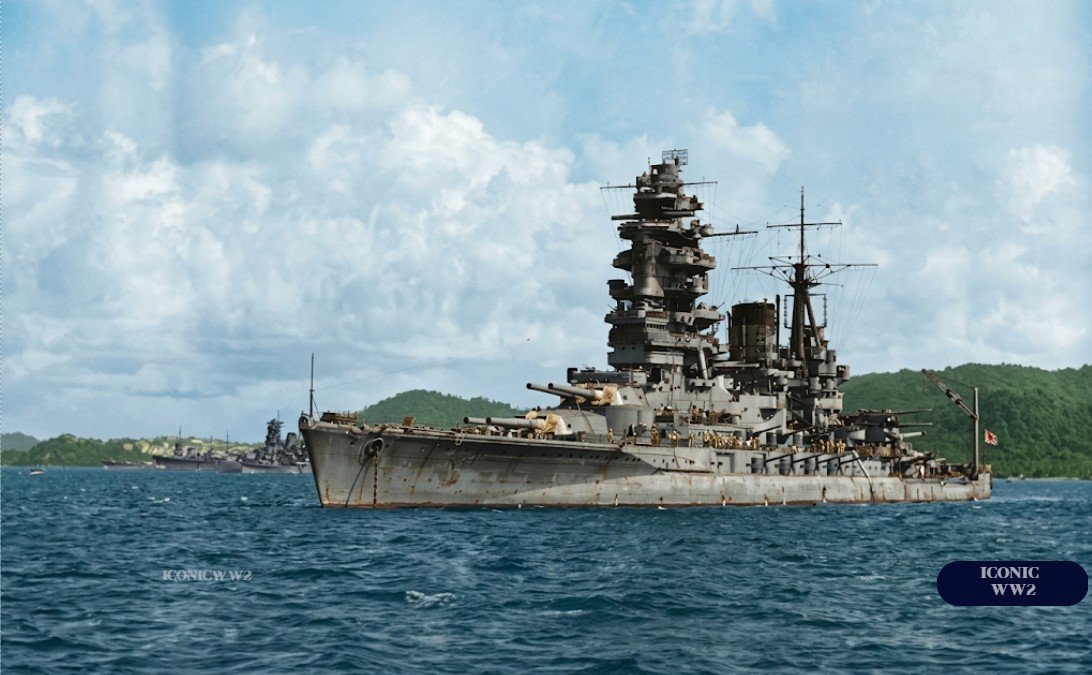
Shinano began life not as a carrier but as a battleship. Laid down in 1940 at the Yokosuka Naval Arsenal, she was the third hull of the Yamato class — sister to the two greatest battleships ever built — and was intended to mount the same monstrous battery of 460mm guns that made Yamato and Musashi the most powerful warships afloat.
But the war overtook her on the slipway. The catastrophe at Midway in June 1942, where Japan lost four fleet carriers in a single day, shattered the assumption that the battleship still ruled the sea and left the Imperial Navy desperately short of flight decks. With her hull less than half complete, the decision was taken to abandon the battleship and rebuild Shinano as something the fleet now needed far more urgently: an aircraft carrier — and, on her vast battleship hull, the largest the world had ever seen.
The result was a warship unlike any other. On the immense armoured hull of a Yamato-class battleship, the yard built a fully armoured flight deck and hangar, producing a carrier of around 72,000 tons at full load — by far the largest aircraft carrier in the world, a record she would hold until the American supercarrier USS Forrestal appeared more than a decade later.
Her conception was unusual. Rather than a conventional strike carrier with a large air group of her own, Shinano was designed chiefly as a heavily protected support and replenishment carrier — a floating base that would carry reserve aircraft, fuel, ordnance and repair facilities to rearm and service the planes of other carriers far forward. Her own air complement was modest, planned at around 47 aircraft, and her true value was meant to lie in her armour and her role as a mobile arsenal.
Above all she was built to survive. Her flight deck and magazines were protected on a scale no other carrier could match, in theory making her almost unsinkable by air attack. But this formidable design masked a fatal reality — the ship that left the builders in late 1944 was dangerously incomplete, her watertight integrity untested and her crew barely formed.
By the autumn of 1944 Japan was losing the war, and the navy was desperate to get its giant carrier to the relative safety of the Inland Sea before the relentless American bombing of the Tokyo area destroyed her at her fitting-out berth. Shinano was therefore hurried into commission on 19 November 1944 in a state that no warship should ever go to sea — many of her watertight compartments were unfinished and had never been pressure-tested, dozens of openings in her hull were not yet sealed, and hundreds of dockyard workers were still aboard.
Her crew, too, was raw — hastily assembled, unfamiliar with the ship and untrained in the all-important art of damage control on which her survival would depend. She was, in truth, a half-built ship with a half-formed crew, sent to sea on the strength of her armour and the hope that she could slip the short distance to Kure unseen.
On the night of 28–29 November 1944, Shinano sailed from Tokyo Bay for Kure, escorted by three destroyers. In the darkness she was sighted by the American submarine USS Archerfish, commanded by Joseph Enright. Unable at first to believe the size of the target, Archerfish shadowed the great carrier for hours, and when a zig-zag turn brought the ship into range, fired a spread of six torpedoes. Four struck home along Shinano's side.
Against a properly completed ship the hits might have been survivable. Against this one they were mortal. Water poured through unsealed compartments and untested bulkheads; the inexperienced crew, unable to control the spreading flood, made errors that hastened the end. Listing ever further, the largest warship in the world capsized and sank on the morning of 29 November — roughly seven hours after the attack and only ten days after she had been commissioned. More than 1,400 men went down with her, including her captain.
She had never launched a single aircraft in anger. Shinano remains the largest warship ever sunk by a submarine, and one of the shortest-lived capital ships in history.
Her loss was a verdict on haste. Converted from a Yamato-class battleship hull into the largest aircraft carrier in the world, she had been rushed to sea unfinished — watertight compartments untested, pumps and fittings incomplete, her crew barely worked up. The greatest carrier yet built was undone not by a fleet but by a single submarine, ten days into her life, because she had been sent to sea before she was ready.
IJN Shinano is one of the great might-have-beens of naval history — the third of the leviathan Yamato sisters, reborn as the largest carrier on earth, and destroyed before she could fire a shot or fly a plane. Her loss was a microcosm of Japan's wider failure in the war at sea: vast resources poured into a magnificent ship, undone by haste, by the collapse of Japanese industry and training, and by the very submarine and air power that had already overturned the age of the battleship.
Her fate also underlined the lesson written across the whole Pacific war — that armour alone could not save a warship. The most heavily protected carrier ever built was sunk on her first voyage by four torpedoes, not because her design was weak, but because she went to sea unfinished and unready. Shinano endures as a haunting symbol of Japan's exhausted, over-reaching navy in the final winter of the war.
- Roger Chesneau (ed.), Conway’s All the World’s Fighting Ships 1922–1946 (Conway Maritime Press).
- Mark E. Stille, Imperial Japanese Navy Aircraft Carriers 1921–45 (Osprey, New Vanguard).
Iconic WW2 is free, ad-free and tracker-free — kept going only by the time it takes to research, restore and colorize each machine. If this profile was worth your read, you can help the archive grow.
| Class | Yamato (completed as carrier) |
| Builder | Yokosuka Naval Arsenal |
| Nation | Japan |
| Type | Armoured fleet/support carrier |
| Laid down as | 3rd Yamato-class battleship, 1940 |
| Commissioned | 19 November 1944 |
| Sunk | 29 November 1944 (maiden voyage) |
| Crew | ~2,400 |
| Distinction | Largest ship ever sunk by a submarine |
| Yamato | Battleship; sunk off Okinawa, 1945 |
| Musashi | Battleship; sunk at Leyte Gulf, 1944 |
| Shinano | 3rd hull — completed as carrier |
| Sunk by | USS Archerfish (SS-311) |
| Machinery | 4× geared steam turbines |
| Boilers | 12 Kampon |
| Power | ~150,000 shp |
| Shafts | 4 |
| Max Speed | ~27 knots |
| Range | ~10,000 nmi at 18 kn |
| Standard Displacement | ~65,800 t |
| Full Load | ~72,000 t |
| Length | 266 m |
| Beam | 36.3 m |
| Flight Deck | ~256 m armoured |
| Draught | ~10.3 m |
| Planned Air Group | ~47 aircraft |
| Role | Armoured support / replenishment carrier |
| Flight Deck Armour | Heavily armoured (Yamato-derived) |
| AA & Guns | 16× 127 mm + heavy AA battery |